Guyana Focus

With general elections in Guyana due on March 2, the changing composition of Guyana’s population could have serious repercussions for the country’s major political parties which have historically embraced racially motivated voting.
There has been increasing talk of voting along non-racial lines but talk has always been cheap when it comes to elections in Guyana.
As a result, unless elections are rigged, the political platform and the track record of the parties will be the main driver of election results as no single ethnic group is large enough to elect a majority government.
The most recent (2012) census results – though dated – indicate that the number of East Indians, the largest ethnic group, has declined steadily, from 394,417 in 1980 to 297,493 in 2012, representing a sharp decrease in percentage terms – from 51.93% of the total population in 1980 to 39.83% in 2012.
During the same period, the African/Black population, the second largest ethnic group, has remained relatively stable at 218,483 in 2012, falling marginally from 233,465 in 1980. In 2012, Africans/Blacks comprised 29.25% of the population, down from 30.82% in 1980.
What this means is that although East Indians remain the major ethnic group, the Peoples Progressive Party (PPP) which relies heavily on East Indian votes can no longer depend on its traditional support base for an electoral victory.
Incidentally, East Indians left Guyana in droves for North America and Europe, particularly during the 1980-1990 decade on the back of reduced opportunities and fear for their lives under the repressive Peoples National Congress administration (now APNU) which ruled Guyana illegitimately from 1968 – 1992. The flight to foreign lands continued thereafter, albeit at a slightly reduced rate.
Although the African/Black population has remained relatively stable, this ethnic group accounts for only 29.25% of the population, which means that the A Party for National Unity (APNU) which derives its support from this segment of the population, also cannot secure a majority electoral victory based on ethnic support alone. In fact, it never could have, which is one of the reasons why the current APNU/Alliance for Change (AFC) coalition government emerged victorious at the 2015 general elections.
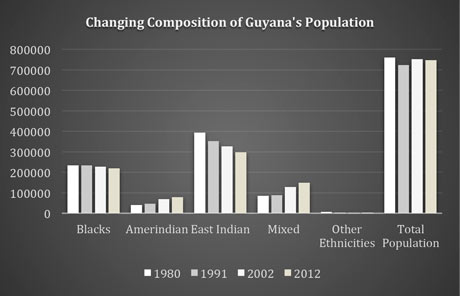
But two major shifts in the ethnic composition of the population will also determine the future of the major political parties in Guyana. The first shift is the dramatic increase in individuals of Mixed Heritage, that is, those who do not belong to a distinct ethnic group.
The number of individuals identified as Mixed Heritage has increased from 84,764 in 1980 to 145,532 in 2012 and currently represents almost 20% of the population, up from 11.2% in 1980. Consequently, this group is now a significant component of the population whose votes can go either way, depending on their ethnic preference, that is, if they are to vote based on one of their ethnic origins.
Incidentally, the increase in the population of Mixed individuals will only grow larger over time as these individuals can only have Mixed children, which will effectively result in a permanent shift in the ethnic composition of the population.
Arguably, this is the scenario that is playing out in favour of the APNU+AFC coalition and is not so much about ethnic cohesiveness as is often portrayed.
The second major shift in ethnic composition is the growth in the Amerindian population, from 40,343 in 1980 to 78,492 in 2012, representing a doubling of this ethnic group from 5.31% of the total population in 1980 to 10.51% in 2012.
Given the decline in the East Indian population and the increase in the Mixed Heritage and Amerindian populations, both major political parties are now dependent on the support of these two emergent groups for political support in order to attain power. Racial voting alone cannot assure victory.
Power in Guyana will therefore rest on the shoulders of the strategies of the individual parties, instead of ethnic loyalties. History has shown that both major parties have been accused of nepotism during their terms in office, accompanied by massive corruption.
The current ruling APNU+AFC coalition which came into power on accusations of corruption within the former PPP administration is now regarded as being worse than the demagogic regime of the late Forbes Burnham, albeit only after one term in office. Former President Bharat Jagdeo has made open accusations of mistreatment of East Indians, claims which have been rebuffed by the ruling government.
But such claims, true or not, are nothing new in Guyana. When the PPP was in power (1992-2015), Africans/Blacks made vociferous claims of being marginalized, garnering international attention. Now East Indians are making similar claims against the APNU/AFC regime.
What this indicates is that there appears to be a tendency for either major party to show favouritism to its traditional base support. The question is: Can the Mixed component of the population, in particular, and to a lesser extent, the Amerindian population, swing voting in favour of either major party?
Or will a particular party’s promises or track record determine success at the polls? Arguably, with ethnicity becoming a less important factor, the party with the best track record will likely win future elections, unless the polls are rigged, as they have been in all elections under the PNC management.
From an ethnic standpoint, all other groups in Guyana, including Chinese, Portuguese, White, and unidentified ethnicities make up just over one-half of one percent of the total population and are therefore insignificant relative to the outcome of general elections.
In spite of changes in the ethnic mix of the population, the East Indian component is still 10% greater than Africans/Blacks, and 10% short of a majority government, which suggests that the APNU+AFC coalition is not necessarily in a comfortable position. This is especially true given that the influence of the AFC, APNU’s coalition partner has vastly diminished. However the emergence of 13 fringe parties, or at least two of these parties, could also influence the pattern of voting.
Ironically, the conditions for electoral rigging are also rife, as an inordinate number of voters, 88.5% of the total population are registered as voters. In a country where, whether one plus one is equal to two, is being questioned and has to be resolved by the court, it is rather surprising, or maybe not, that 661,028 people of a population of 746,995 are registered to vote!
The unions, in collaboration with Move On Guyana Inc, last Thursday evening hosted a debate featuring candidates from parties contesting the 2020 polls. However, the two major parties, A Partnership for National Unity + Alliance for Change (APNU+AFC) coalition and the People’s Progressive Party/Civic (PPP/C) did not participate.
President of the University of Guyana Senior Staff Association (UGSSA) Dr Jewel Thomas told the audience gathered at UG’s Education Lecture Theatre that if any party was not represented at the debate, it was due to their reluctance to respond to or accept the invitation. She had noted that invitations were extended to all the parties. Thomas said that they also presented an option to have another representative of the parties be present at the debate as it was understood that those presidential candidates may not be able to attend the event.
Thomas said that they decided to go ahead with the event while attempting to secure the participation of those parties that will be contesting in all 10 administrative regions for another time.
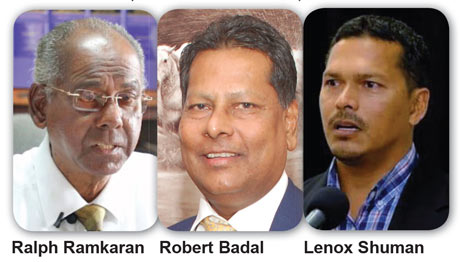
As a result of the non-participation of the two main parties, the debate featured candidates from five of the smaller new parties not contesting all administrative regions. They were Ralph Ramkarran of A New United Guyana (ANUG), Robert Badal of Change Guyana (CG), Lennox Shuman of the Liberty and Justice Party (LJP), Rondha Ann Lam of The Citizenship Initiative (TCI) and Dr Asha Kissoon of The New Movement (TNM).
The presidential candidates for Change Guyana (CG), the Liberty and Justice Party (LJP) and A New and United Guyana (ANUG) called out the two parties’ reluctance to face the heat and questions from citizens. According to ANUG leader Ralph Ramkarran, the fact that the parties were not present suggested to him that the major parties share the view that the new/third parties are achieving “a great deal of traction.”
CG’s leader Robert Badal said they were looking forward to the opportunity to have meaningful debate with the two major parties. He, too, said that he feels that the parties “ran scared of new talent” along with new measures that can be presented by the new parties.
LJP Presidential Candidate Lenox Shuman told the gathering that he feels that an event like the debate is one which is long overdue. However, he wished that the major parties could have been present as he said the newer parties do not have records and policies to defend.
The GRA said that the Contractor and the Sub-Contractors engaged in Petroleum Operations shall be permitted to “import, free of duty, VAT or all or any other duties, taxes, levies or imposts, all equipment and supplies required for Petroleum Operations including but not limited to drill ships, platforms, vessels, geophysical tools, communications equipment, explosives, radioactive sources, vehicles, oilfield supplies, lubricants, consumable items (other than foodstuffs or alcoholic beverages or fuel), as well as all items listed on Annex D.
“In keeping with the said clause, the Guyana Revenue Authority advises that the supplies outlined in Annex D whether procured locally or overseas shall be sold to the Contractor (EXXON) in accordance with the said Article 21.1, i.e., free of duty, VAT or all or any other duties, taxes, levies or imposts.
“Consequently, suppliers of items to Exxon as listed in Annex D, on which taxes were levied and paid upon import, are advised that a credit shall be given for the said taxes, once proven to the satisfaction of the Commissioner General that such items were indeed sold to EXXON, and taxes were paid upon import”.
The GRA said that note should be taken that foodstuff, alcoholic beverages and fuel are subject to the appropriate tax, and will be so taxed regardless of whether the supplier is local or otherwise.
a few months ago
The fire started around 2.30 am and quickly ripped through the three-storey concrete building, located at Lot 136 Regent Street.
The building was being rented to Chinese nationals, who operated a variety store on the ground floor. Nothing was saved.
A cell phone store, RW Mobiles, which was situated on the western side of the building, was also destroyed.
Fire Chief Marlon Gentle said that the Guyana Fire Service received several calls and as a result a number of fire tenders were dispatched. Upon arrival, Gentle said, firefighters noticed that the lower flat of the building was already engulfed and the fire had already spread to the middle flat.
He said in an effort to prevent the fire from spreading to nearby buildings, additional resources were mobilised. A fire hydrant in the vicinity was also activated.
“…When they got here they realised that this fire had already moved to the two floors of the building and therefore we had to go to defensive tactics to contain this fire,” Gentle said.
He explained that the main concern was the nearby buildings. Gentle said the plan “worked well” and the firefighters were able to contain the fire after about two hours. He explained that a preliminary investigation suggested arson.
He said investigators have since discovered several items and evidence which revealed that person/s might have gained access to the building shortly before the fire started.
“Investigators have uncovered some evidence that points into the direction of arson. They found things like welding torches, cutting torches, crow bars, drills and other implements that can only be used to break into a building and also some grills were cut from the back and some security features were damaged… it basically suggest that person/s would have gained entry into the building. After then the fire would have started,” Gentle explained.
Some employees rushed to the scene upon learning of the fire, while others turned up for work only to be greeted with the tragic news.
The Guyana Power and Light (GPL) was also summoned and electricity was disconnected to sections of Region Street. As a result, several stores were unable to open as usual for business yesterday morning.
However, after power was restored, a number of them opened later than usual, while others, including Dhoray’s Fashion and Royal Jewel House remained closed for the day.
The owner of the building was present at the scene but refused to comment.
Fa Sen, the Chinese national who operated the store on the lower flat of the building, was unable to estimate his loss.
He told reporters that his store was fully stocked and everything was destroyed.
Latisha Gittens, a sales clerk, said that she and her colleagues planned to support him. “Right now we all plan to stay behind our boss and we will move on from there,” Gittens said.
Gittens and a other of her colleagues remained at the scene up to late in the next day as they assisted in clearing the debris.
Based on information received, police set up a road block along the Number 51 Village, Corentyne Public Road to intercept the three suspects.
After a search was conducted, a gun, ammunition, ski masks and dark coloured clothing were found in the vehicle in which the men were travelling and this led to them being placed under arrest.
A police source told the media that the men admitted to using AK-47 rifles to commit the robberies.
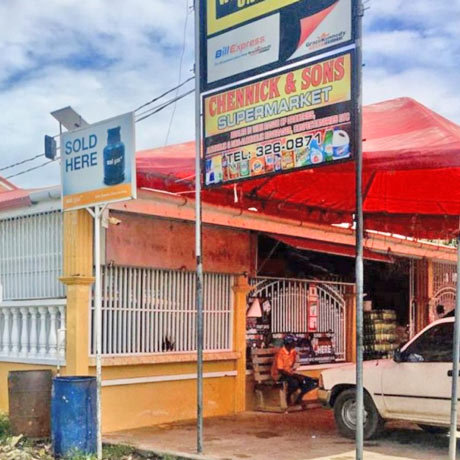
One major robbery that they have reportedly confessed to was one at the Chennick and Sons Supermarket where the proprietor was beaten before they stole a chest containing a large sum of cash.
Meanwhile, based on their investigations, the police then placed the Rose Hall businessman, who is the father of one of the alleged bandits, under arrest.
The businessman, who operates a grocery and liquor business, was arrested as an accessory to the robberies the men were allegedly involved in.
According to a police source, it was discovered that the businessman would resell the stolen items in his store.
The source related that the police have received information previously about the businessman but he has never faced the law due to the intervention from a now former senior officer, who is a close friend.
To advertise in ICW call
Call 905-738-5005