Trinidad & Tobago
Go outside and play
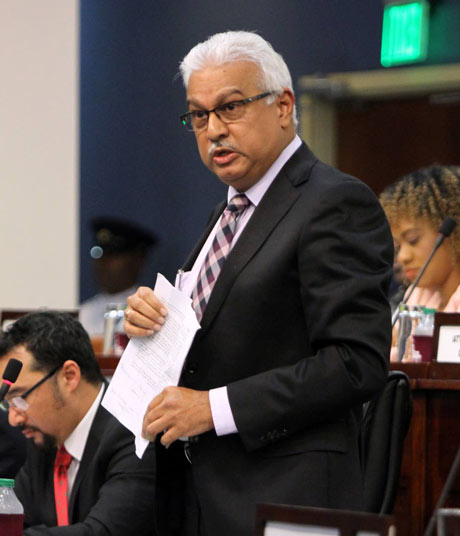
Port-of-Spain – Health Minister Terrence Deyalsingh last week called on parents to get children more physically active, saying the young ones were spending too much time in front of the television and with electronic devices.
“I feel there is still a need to kick your children outside to play cricket, to kick a ball, to play hop scotch, to skip rope. But we don't do that and then you present to the hospital as an 18-year-old with diabetes, hypertension, and we have to dialyse you for the rest of your life,” he said.
Deyalsingh was addressing the opening ceremony of the National Symposium on Strengthening Primary Health Care.
“The human body has evolved with something called opposable thumbs, which is when the thumb opposes the other four fingers. But why did we evolve to have opposable thumbs? To pelt a ball, to hold a cricket bat, to pelt mangoes, to throw a volleyball,” he pointed out.
Illustrating with both thumbs on his smart phone, Deyalsingh said: “But do you know what opposable thumbs are now being used for by children? And worse yet, they do this while sitting down in a chair in front of a TV with a can of soda and a bag of potato chips,” he said.
He said personal responsibility was a key factor in tackling Non-communicable Diseases such as heart disease, cancer, diabetes, and hypertension.
“Everybody asks a government, ‘What are you doing about the problem? What are you doing about Zika? What are you doing about malaria? What are you doing about diabetes?’ But you know who we never ask about what they are doing – the patient,” he said.
“We never ask you what are you doing to safeguard your health? We always leave it to the government. But what are you doing? What is the taxi-driver doing when he sits all day in a vehicle suffering from a certain disease? Does he have the capacity to recognise that when he goes home on an evening he needs to exercise, he needs to walk?” Deyalsingh questioned.
He said if NCDs were left unchecked, hospitals and health centres would have to be built in every community.
“Because your population gets sicker and more and more obese because they will flood into your [Accident & Emergency] and demand services,” he emphasised.
He commended local soft drink and juice manufacturers for voluntarily and significantly reducing the sugar content in their products over the past year.
“Many countries are grappling with how to reduce sugar content in soft drinks. Some tried to do it legislatively. It failed in New York. What we did in Trinidad and Tobago is we did not try to go the legislative, the punitive, or the taxation method. We tried to go by moral suasion,” he stated.
He said the ministry then moved into the schools and banned the sale of soft drinks and juices with added sugars, which is expected to have a direct positive impact on the population and schools.
“An obese, diabetic child will give you an obese, diabetic adolescent, which will give you an obese, diabetic adult,” Deyalsingh said.
He said according to an IDB study, the economic burden of NCDs to Trinidad and Tobago was about (TT) $8.7 billion annually, with diabetes alone costing $3.5 billion.
“Do you know what a government can do with $8.7 billion if we did not have to spend it on treating NCDs? And that represents about five percent of Gross Domestic Product,” he emphasised.
He said in 2007, Trinidad and Tobago awoke to the issue of NCDs, but immediately “went to sleep” on it. However, the country was once again waking up to the issue, he declared.
“I urge all – do not let Trinidad and Tobago fall asleep again on NCDs because if you do, you will not be able to afford the cost of treating patients,” he stressed.
Meanwhile, parenting groups have agreed with Health Minister Terrence Deyalsingh, saying children should spend more time outdoors rather than being inside playing electronic devices.
Sharla Dwarika, executive director of Parenting TT, an organisation which focuses on parent education, support and family empowerment, said Deyalsingh was right.
“There should be a balance between outdoor and indoor activities, between outdoor playtime and indoor screen time,” she said.
“We try to ensure that parents understand that while screen time is very good for focus and certain development skills, too much of it could also impact upon their social development,” she added.
Head of the Single Fathers Association Rhondall Feeles viewed exercise as an important part of children's development.
“You just can't have children excelling academically, and physically you allow them to dwindle. There are studies that show that when they are involved in exercise, it helps with the development of their brain, so I support the minister's statements,” he said.
Fonda Samuel, administrator of two popular Facebook parenting and health support groups – the Trini Moms Group and Trini Moms Health and Fitness Group also concurred.
“I would tend to agree with the honourable minister. Far too many kids don't play outside anymore – they are content with just being stuck inside all day behind a screen. I believe that screen time should be limited and children should be encouraged to be more active,” she said.
“I am also fully aware that in these times we live in, with all the crime, that may be a serious challenge for some people,” she noted.
Women's rights activist Hazel Brown said while she agreed with Deyalsingh, efforts should be made to create safer play areas for children.
“Why would anybody not agree with the minister? The only requirement, of course, is that there are safe spaces for the children to play in,” she said.
Brown said apart from simple outdoor games like hopscotch, it was important for parents to get girls involved in organised sports like netball, football, and athletics.
for fatal crashes
These statistics were presented by Acting Snr Supt Basdeo Ramdhannie of the Traffic Branch last week.
Referring to two deaths earlier this month in separate road accidents, Ramdhannie said: “What is extremely upsetting is the high level of predictability involved in both of these incidents. Drivers who are in the first vehicle at traffic light-controlled intersections wait three to four seconds before moving off on a green light to ensure the intersection is clear. Do this even if it causes the driver behind to sound the horn. Remember you are the most at risk moving off first from the light.”
Speaking to drinking and driving, Ramdhannie said: “We continue to advise drivers not to consume alcohol if they are driving. Utilising taxis, calling friends or family and ride-sharing options are always the best alternatives to taking the chance of driving under the influence of alcohol.”
Ramdhannie noted a total of 15,928 speeding tickets were issued to motorists for speeding. The tickets cost drivers (TT) $15,928,000, with 35 percent of these issued by the Traffic and Highway Patrol speed teams, with the other 65 percent issued by divisional speed teams along the main roads.
Ramdhannie added: “Although there has been a 40 percent decrease in deaths recorded along the major highways, excessive speeding continues to be one of the main contributing factors to fatal and serious road traffic deaths.”
The minister made the declaration following complaints from a Penal grandmother that her grandchildren had been physically punished by teachers in separate instances for dropping a book on the floor and for visiting the washroom without permission.
Francis told the media the ministry’s position on corporal punishment was clear.
“The ministry does not condone corporal punishment and teachers know that it is against the law to hit students,” he said. He said he also never believed in administering corporal punishment. Francis spent most of his career in academic teaching.
“There comes a time when the child becomes unconcerned about being hit. It does not work except to harm the child. There are other ways you can discipline a student. My experience is you empower the child and build a relationship with them. You motivate them to do what is right and if you are successful in empowering them, they will do what is right,” Francis said. He added that rebellious children are not necessarily a bad thing.
“Students should ask questions and challenge their teachers intellectually. It is how the teacher reacts to this challenge is what is important,” Francis said. He noted he did not have any information about the incident at the Penal school, noting the matter is now under investigation.
Francis also said the ministry’s Student Support Services will provide counselling to the pupils if needed.
Last week the children’s grandmother said a school supervisor contacted her and requested she file an official report about the incident to the ministry. She said the official also advised her against going to the principal for a meeting.
The grandmother said she was relieved that the ministry was investigating the complaint, adding that it was not the first time that a teacher had beaten students. She said the children were being physically disciplined for no good reason, adding it was “time that teachers realise hitting students is against the law”.
Last Wednesday the woman’s nine-year-old granddaughter told students she needed to use the washroom. The teacher was not in class and it was an emergency. When the student returned the teacher struck her on the hand and said she was not to leave without his permission. The grandmother said a year ago the same teacher also forced the child to stay back after school, causing her to miss the bus and having to walk home. The grandmother accused the teacher of putting her child’s life in danger by letting her walk home.
The issue was raised in Parliament on Friday when Government Senate Leader Franklin Khan told UNC’s Wade Mark the incident was being investigated, “following which (probe), appropriate follow-up action will be taken if necessary”.
of pepper spray
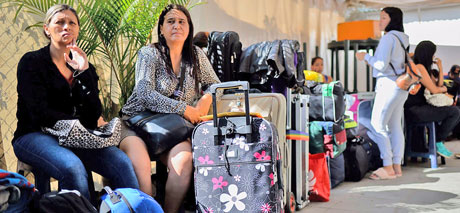
to leave the country.
Responding to an urgent question from UNC Senator Wade Mark, Dillon said based on discussions between himself and the acting Commissioner of Police, the Police Service was conducting an assessment and analysis of the use of “non-lethal responses”, including pepper spray. “On completion of those investigations and analysis, recommendations will be submitted and dealt with accordingly,” said Dillon.
Mark asked in light of the “urgency of the (crime) situation, particularly affecting our womenfolk”, whether Dillon could give a time frame for the submission of the report.
Said Dillon: “The question of the non-lethal use of weapons had always been an issue for consideration”, adding he was sure the matter would be dealt with in a shorter time frame under this administration than it was under the previous government.
Anita Hankey, a senior planning officer at the Ministry of Energy, and the woman who was attacked by bandits at her Curepe home last Thursday, said the authorities must look into the use of devices like Tasers and pepper spray in the context of the devices being used against women who ought to have access to measures to defend themselves.
A number of calls have been made to the government to legalise pepper spray. Dillon had given a similar response to the Parliament when a similar question on the legalisation of non-lethal weapons was asked earlier this year.
Khan has called for a reconciliation with the Pandays, Vasant Bharath, and Jack Warner, and noted he was saddened no attempt was being made to work together.
The only way to remove the People's National Movement would be to join all opposing parties together, he said last week.
Attorney Mickela Panday, daughter of former prime minister and UNC founder Basdeo Panday was planning a meeting last week for young people to share information and find a way forward. The senior Panday told the media youths seem lost and in need of direction. Whether a new political party emerges out of this meeting would depend on what was decided at the gathering, Panday said. Khan was not pleased at this, saying the Pandays did not seem to understand there is need for the political parties to unite against the PNM.
“The Opposition can only go into government when the crab in the barrel syndrome stops. And, unfortunately, I have seen everybody doing their own thing. We have now Mickela and Mr Panday, who should know better; you have COP and other parties and what they don't seem to understand that in 2010 when the accord came and they had all the parties joining together, that was the only way the PNM was able to be removed. We are like fools working for the PNM by separating ourselves,” he said.
Khan said by working as separate entities the parties were simply keeping the PNM in office.
“So I am indicating that somebody has to take the reins and call for unity among all the opposition members to try to work together. Not try to take separate votes, you just working to keep the PNM in power,” he said.