Opinions
"Celebrating"
Pélerinage des Gitans in Saintes-Maries-de-la-Mer, France, on May 24-25, to honour the goddess Kali, whom they call Sara Kali. May the world over ushers in a variety of spring and summer festivals, to please everyone. But for me there is one dark spot. For 52 years, Guyanese have been recruited to celebrate May 26th as Guyana’s independence anniversary. This seems okay if you’re ignorant of Guyanese history. Not many in Guyana, or Canada, have bothered to remind or inform you that on that date in 1964 and the days immediately preceding, Indians living in Wismar-Christianburg-Mackenzie area were targets of politically generated beatings, rape, destruction of property, and terrorism, which killed many, injured thousands and sent the majority fleeing to the coast. This event occurred during a long strike in the sugar industry, on the coast, starting in February and involving clashes between Indian strikers and African strike-breakers, intensifying the prevailing animosity between the two working classes; both sides suffered injury and deaths.
Two Africans killed on May 22 at Buxton, an African stronghold, by persons unknown, were used at Wismar to escalate attacks on Indians, which had started two days earlier. A campaign of terror followed over the next four days, which emptied the Wismar-Christianburg area of Indians; many were killed, (?176, exact number not known), thousands evacuated from homes, properties set afire; businesses and homes looted; women and pre-teen children raped, some even witnessed by Police. The Forces were overwhelmed, their head asserting that the attacks were organised, and that many of the attackers were from the coast, who knew exactly where Indian homes were located, even in areas of mixed housing.
In the next weeks, with the Army present, Indians began to trickle back, mainly those with jobs and assets. On July 6th, an on-board explosion sank the launch Son (or Sun) Chapman at Hurudaia, 16 miles from Wismar, killing 43 people, all Africans. Immediately after, five Indians were killed and many seriously injured, and given refuge by the Hospital staff. The Indians who had returned to Wismar, suffered again; some lost their lives; the other crimes were repeated. The actions were part of the Peoples National Congress’s X-13 plan of civil insurrection to seize the country, with the approval of the US (CIA), part of the Cold War plan to expel the Peoples Progressive Party and Cheddi Jagan, for which dynamite sticks and blasting caps were sent to Wismar on the launch, whose explosion, said to be caused by storage of the explosives too close to the engine, as I learned directly from Professor Albert Nedd, a personal friend, of Edmonton, Alberta, a PNC advocate, who had worked with DEMBA in 1964.
Responding to comments in 2003 by his colleague, Hamilton Green, he wrote a letter to the Daily Chronicle on June 6, 2003 titled, “I Hold the PNC Responsible for Sun Chapman Demise.” (See letter on page 19)
An apology, even a token one, was never given, to my knowledge. A memorial was erected at Hurudaia for the Sun Chapman victims, but none for the slain, dispossessed and exiled Indians. Today, Guyanese press reports and journalists keep inventing doubts, and agitate for an explanation of the explosion. It wasn’t sabotage; it was an accident due to careless storage of explosives near a hot engine. Not many Indians live there now, renamed Linden to honour Burnham.
When Slade Hopkinson was Burnham’s consul in Toronto, I rejected his invitation to join the celebration, asking instead for a memorial to be erected in Wismar. He laughed, “From Odo? We do as he says!” Slade was seriously ill throughout that time; there was nothing he could do; subsequent consuls advised me to accept reality, and be patriotic, even Geoff Da Silva, a friend. I refused to celebrate, and observed a memorial instead. Jagan had promised one, but it was not a priority; he died before anything was done. I urge you to use the day to remember the victims of the savagery of one race against another, their countrymen. Demand a memorial.
In a recent article (GC, June 4th, 2003) Mayor Hamilton Green stated that the “Sun Chapman”, a river launch owned and operated by Norman Yacoob Chapman, was blown out of the water at Hurudaia, near Wismar, on July 6, 1964, and that this incident led to the Pogrom against Indo-Guyanese living in Wismar.
What Mayor Green failed to state, and I know that he knows the true Story as he was intimately associated with the UF-PNC’s campaign of destabilization in 1962, 1963 and 1964, was that the explosion was caused by the accidental explosion of a number of detonators that were carelessly stored near the heated engine room of the “Sun Chapman”. These detonators, as the good Mayor must undoubtedly remember, were bound for PNC operatives in the Mackenzie-Wismar-Christianburg area for use in X-13 operations against perceived PPP supporters.
I know all of this because while I was employed at DEMBA in Mackenzie I had many close relatives who were active PNC members and operatives in the area and, as a result of intelligence supplied by them, I knew that the detonators were coming down on the “Sun Chapman”. Following the incident it was reported to Dr. Jagan that the explosion of the “Sun Chapman” was caused by accidental detonation rather than by any act of sabotage.
To this day I hold the PNC responsible for the deaths of those Afro-Guyanese aboard the “Sun Chapman”.
Yours sincerely,
A. Nedd
Alberta, Canada. JUNE 6, 2003
Radio opens up a brave, new world
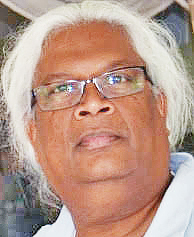 Romeo Kaseram
My nemesis Davey came to our front gate just after the sun had gone down and the mosquitoes were rousing up into symphonic formation, the excitement shining out of his eyes like flashlights. This time he shook the gate with news that was enough to shake the foundation of the small world in which we were growing up. “My father brought home a radio he found in the dump. He plug it in and at first it smoked, but then it warmed up and started to play, and not only that – it is picking up stations from around the world! My father found an away-radio” he said, describing it to be
foreign-made as he clutched the chicken-wire with both hands and peered into the darkness at my approach. “All my father does is turn the knob, and we hearing people talking in all kinds of different languages. Last night we heard people talking from China; then my father started to turn the knob easy-easy, and we started to hear people talking in Spanish. Each time he turn the knob a crack, people from far away started speaking in different languages.”
This was enthralling news. The one time I had come across another language where I was growing up had been quite accidental and a little disquieting. There was that visit to one of my grandmother’s sisters in a distant, rural place, where in passing from a room to go to the kitchen downstairs, I had found a box in a dusty corner containing books. Curiosity had got the better of me, halting me in my tracks since it was unusual to discover a box filled with the items I was always seeking out. Knowing I should have kept going down to the kitchen, instead I stooped and began digging through the dust and cobwebs, lifting out book after book only to keep discovering to my dismay its pages were filled with an unreadable inked script.
So engrossed was I with leafing through the ancient texts, the pages yellow and brittle, the dry smell of rot and cockroaches overpowering the corner, my fingers becoming sticky with desiccated shreds of cobwebs still holding the papery legs of insects, I did not hear someone coming behind me.
“Little boy, you should mind your business when you visit somebody’s house,” the voice said. It was as ancient and dry as the books themselves, and I turned to discover an aged pair of eyes looking down a hawkish, disapproving nose at the book in my questing hands. The old man’s action was pre-emptive and annoyed as he snatched the book from me, closing it roughly so grit lifted out of its pages to float as motes in the sunlight, its dust falling to my feet on the floor.
“These books belonged to my father, and his father before him. See the Hindi inside? He brought these books with him on the ship from India. They are not for little boys to touch and tear and rip. You could read Hindi, little boy?”
My response was respectful as my grandmother had taught me. However, I did not put my hands together as she had told me to do when greeting older people, neither did I bow my head, since I had quickly made up my mind this irascible old man was undeserving of the full rites of respect. So, I replied respectfully, saying “No, Nana. I don’t know how to read Hindi”, not in response to the wrinkles that covered his forehead, nor to the fishing-net pattern of skin on his arms, but to smooth out anger flashing in his eyes and in the flaring of the nostrils on that hawkish beak that was his nose.
This is how it was as a young boy I came to discover the written word could be inscribed as an orthography, a language represented as symbols and characters on pages so ancient and old that it had cracked, with pieces broken off at the corners of the books collected in this abandoned box.
So when Davey came to our gate with the breaking news his father had not only brought a radio from its grave at the dump and resuscitated it back to life so it awoke and began talking in tongues, it was enough for me to brave walking down the stairs to the front gate as the darkness grew to the same intensity as the black pitch on the road, and the mosquitoes began tuning up their wings to take to flight.
Said Davey: “My father told me if he had found this radio before, he would have been able to pick up the people talking when they were on the moon.” So stunning was this revelation we sat so we could better look to the sky at a gibbous, emerging moon.
“You know what I think?” Davey said, slapping his leg as the mosquitoes began attacking, “I think the radio bigger inside than outside. How else all these people could live inside the radio, and talk to each other in so many different languages?”