Guyana Focus
economic woes?

It shouldn’t be a surprise to anyone but all bets are on oil to spur Guyana’s economic growth and ease its debt burden.
That’s the conclusion of an International Monetary Fund (IMF) mission which visited Guyana during the period April 23 – May 3 this year.
The question that therefore begs to be asked is: what if oil were not to come on stream? While the government proclaims commitment to growth of the non-oil economy, it would appear that such growth is not on the horizon – without oil.
In arriving at its conclusion, the IMF Team, in a Press Release issued on May 9, stated that it met with Finance Minister Winston Jordan, Natural Resources Minister Raphael Trotman, Central Bank Governor Gobind Ganga, other senior officials, representatives from the private sector, the opposition party, labor unions, and other stakeholders.
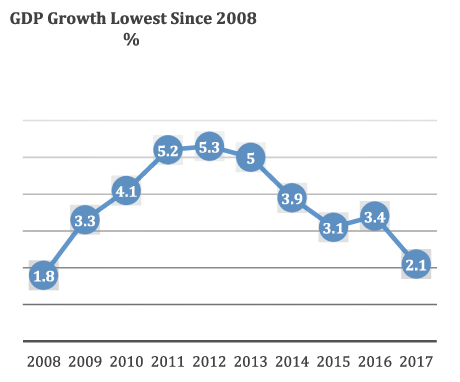
Noting that Guyana’s medium-term prospects are favorable, the mission stated that the commencement of oil production in 2020 will be a turning point for the economy whose growth slowed last year to its lowest level since 2008 (See Chart: GDP growth lowest since 2008).
Incidentally, the country’s GDP growth fell to 2.1% in 2017, down from 3.4% a year earlier. Previously in 2007, GDP growth hit a decade-old low of 1.8%, following a dramatic decline from 7.2% the year before.
The IMF mission projects real economic growth of 3.4% for 2018, driven by continued strength in the construction and rice sectors, and a recovery in gold mining.
According to the global financial watchdog, while growth declined in 2017, it was more broad-based. Arguably, this statement is without merit. The slowdown was attributable to weaker than expected mining output and weak performance in the sugar sector., with the mining sector declining by 2.3%, sugar by 17.2%, and forestry by 7.2%.
On the other hand, on the positive side, construction expanded significantly by 13.5%, buoyed by higher public and private investments; rice production recovered from weather-related shocks in the previous year to grow by 12.7%; manufacturing was up 3.6%; agriculture, forestry and fishing by a meagre 0.2%; livestock by 4.4%; and services by 3.1%.
Besides strong growth in the construction sector, there is no evidence to suggest that last year’s growth was more broad-based than most other years. Historically, the performance of all sectors has been cyclical, with winners and losers changing places over time.
Regardless, weaker than expected export growth, in combination with higher oil prices, have also contributed to the current account balance turning negative, says the IMF mission. In 2017, the current account recorded a deficit of 6.7% of GDP from a 0.4% surplus in 2016. The deficit was largely financed by Foreign Direct Investments, particularly in the oil and gas sector, and higher loan disbursements to the public sector.
Incidentally, the country’s GDP growth fell to 2.1% in 2017, down from 3.4% a year earlier. Previously in 2007, GDP growth hit a decade-old low of 1.8%, following a dramatic decline from 7.2% the year before.
The IMF mission projects real economic growth of 3.4% for 2018, driven by continued strength in the construction and rice sectors, and a recovery in gold mining.
According to the global financial watchdog, while growth declined in 2017, it was more broad-based. Arguably, this statement is without merit. The slowdown was attributable to weaker than expected mining output and weak performance in the sugar sector., with the mining sector declining by 2.3%, sugar by 17.2%, and forestry by 7.2%.
On the other hand, on the positive side, construction expanded significantly by 13.5%, buoyed by higher public and private investments; rice production recovered from weather-related shocks in the previous year to grow by 12.7%; manufacturing was up 3.6%; agriculture, forestry and fishing by a meagre 0.2%; livestock by 4.4%; and services by 3.1%.
Besides strong growth in the construction sector, there is no evidence to suggest that last year’s growth was more broad-based than most other years. Historically, the performance of all sectors has been cyclical, with winners and losers changing places over time.
Regardless, weaker than expected export growth, in combination with higher oil prices, have also contributed to the current account balance turning negative, says the IMF mission. In 2017, the current account recorded a deficit of 6.7% of GDP from a 0.4% surplus in 2016. The deficit was largely financed by Foreign Direct Investments, particularly in the oil and gas sector, and higher loan disbursements to the public sector.
In the meanwhile, the IMF mission said the fiscal deficit remained stable in 2017 at 4.5% of GDP, lower than the budgeted 5.6%. This better than expected out turn was largely supported by higher revenue arising from improvements in tax administration. However, it is projected that in 2018, the deficit will widen to 5.4% of GDP due to the cost of restructuring the sugar industry, including severance payments to displaced workers, as well as an increase in infrastructure related capital expenditure.
Guyana’s economy will however turn for the better in 2020 and onwards with oil contributing to higher revenues, as well as the economy benefitting from spillovers of oil activities into other supporting services. As a result, the country’s persistent negative balance of payments position will become sharply positive after 2020.
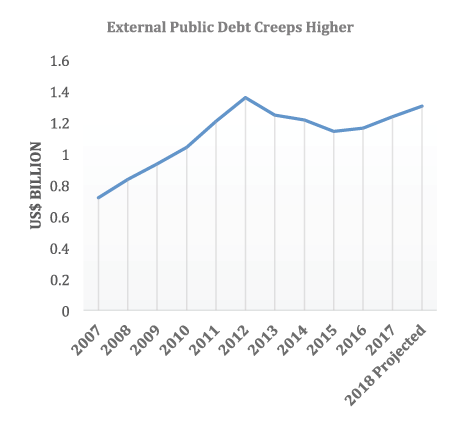
In turn, oil revenues will also allow the country to reduce its public debt which has been on an upward trend. Projected to the end of 2018, Guyana’s total public debt is US$1.756 billion, comprising of US$1.365 billion in external debt (See Chart on External Public Debt Creeps Higher) and US$481 million in domestic debt. Total public debt is estimated at US$1.662 billion at the end of 2017.
While the IMF mission recognizes that concerns about debt sustainability will be lessened by future oil revenues, it contends that financing of short-term deficits should be carefully managed.
It expressed support for the government’s prudence towards private external borrowing and encouraged it to rely to the extent possible on Development Banks, including non-concessional financing, and to follow up on its plans to develop the domestic bond market. The mission also stressed the importance of settling government balances at the Bank of Guyana, which it says can be achieved by the issuance of Treasury Bills.
The mission expressed support for continued efforts by the government to enhance the quality and efficiency of government expenditure and tax administration. It commended the steps taken in response to the Public Investment Management Assessment (PIMA) in 2017, but cautioned that scaling up public investment without addressing remaining shortcomings could undermine its effectiveness.
The mission also recommended moderating spending increases and the consideration of an expenditure review which could provide opportunities for safety net reform and more effective action on inclusive growth.
The IMF team also said that productivity-enhancing reforms are needed to improve competitiveness, and facilitate inclusive growth and noted that infrastructure bottlenecks and high energy costs remain obstacles to growth. Meanwhile, notwithstanding significant upside benefits, the prospect of revenue from the oil sector could lead to real exchange rate appreciation, eroding competitiveness in some sectors.
Therefore, regulatory and administrative measures should aim to reduce the relatively high costs of doing business in Guyana.
The mission welcomed the ongoing restructuring of the sugar sector, but underscored the importance of training displaced workers and providing an adequate safety net to contain the short-term economic and social costs.
Evidently, the prospects for the future of Guyana undoubtedly looks bright because of oil. But the government needs to address issues related to economic malaise, without relying solely on oil.
Guyana’s economy will however turn for the better in 2020 and onwards with oil contributing to higher revenues, as well as the economy benefitting from spillovers of oil activities into other supporting services. As a result, the country’s persistent negative balance of payments position will become sharply positive after 2020.
In turn, oil revenues will also allow the country to reduce its public debt which has been on an upward trend. Projected to the end of 2018, Guyana’s total public debt is US$1.756 billion, comprising of US$1.365 billion in external debt (See Chart on External Public Debt Creeps Higher) and US$481 million in domestic debt. Total public debt is estimated at US$1.662 billion at the end of 2017.
While the IMF mission recognizes that concerns about debt sustainability will be lessened by future oil revenues, it contends that financing of short-term deficits should be carefully managed.
It expressed support for the government’s prudence towards private external borrowing and encouraged it to rely to the extent possible on Development Banks, including non-concessional financing, and to follow up on its plans to develop the domestic bond market. The mission also stressed the importance of settling government balances at the Bank of Guyana, which it says can be achieved by the issuance of Treasury Bills.
The mission expressed support for continued efforts by the government to enhance the quality and efficiency of government expenditure and tax administration. It commended the steps taken in response to the Public Investment Management Assessment (PIMA) in 2017, but cautioned that scaling up public investment without addressing remaining shortcomings could undermine its effectiveness.
The mission also recommended moderating spending increases and the consideration of an expenditure review which could provide opportunities for safety net reform and more effective action on inclusive growth.
The IMF team also said that productivity-enhancing reforms are needed to improve competitiveness, and facilitate inclusive growth and noted that infrastructure bottlenecks and high energy costs remain obstacles to growth. Meanwhile, notwithstanding significant upside benefits, the prospect of revenue from the oil sector could lead to real exchange rate appreciation, eroding competitiveness in some sectors.
Therefore, regulatory and administrative measures should aim to reduce the relatively high costs of doing business in Guyana.
The mission welcomed the ongoing restructuring of the sugar sector, but underscored the importance of training displaced workers and providing an adequate safety net to contain the short-term economic and social costs.
Evidently, the prospects for the future of Guyana undoubtedly looks bright because of oil. But the government needs to address issues related to economic malaise, without relying solely on oil.
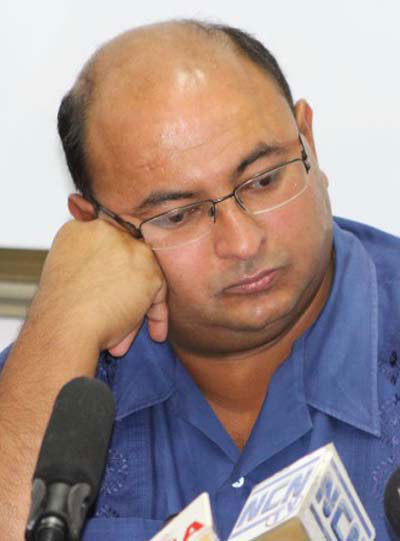
Georgetown – Justice Franklyn Holder on Monday handed down a ruling at the Georgetown High Court, which has temporarily halted the criminal proceedings against former Minister of Finance, Dr. Ashni Singh and former Head of the National Industrial and Commercial Investments Limited (NICIL), Winston Brassington.
Singh and Brassington are facing a trial in the Magistrates’ Court for alleged Misconduct in Public Office.
Following a private hearing at the Court Monday, Defence Attorney, Anil Nandlall told reporters that Justice Holder granted an interim stay of proceedings pending before Chief Magistrate Ann McLennan in relation to Singh and Brassington, until the hearing and determination of the substantive challenge over the validity of the charges which is before Chief Justice (ag) Roxane George.
In addition to the application to temporarily stay the proceedings in the Magistrates’ Court, Nandlall had also filed a Fixed Date Application, (FDA) before the Chief Justice to challenge the basis and legality of the charges against the two former public officials.
Meanwhile, Solicitor General Kim Kyte, who presented the State’s case against the two men, noted that the Judge granted the application in the interest of protecting the judicial process.
“The Judge’s only reason for granting the application is to protect the judicial process. The Magistrate cannot be dealing with the matter at the same time that the Chief Justice is hearing the case in the High Court,” Kyte stated, adding that the Supreme Court takes precedence over the lower Courts.
Singh and Brassington are facing a trial in the Magistrates’ Court for alleged Misconduct in Public Office.
Following a private hearing at the Court Monday, Defence Attorney, Anil Nandlall told reporters that Justice Holder granted an interim stay of proceedings pending before Chief Magistrate Ann McLennan in relation to Singh and Brassington, until the hearing and determination of the substantive challenge over the validity of the charges which is before Chief Justice (ag) Roxane George.
In addition to the application to temporarily stay the proceedings in the Magistrates’ Court, Nandlall had also filed a Fixed Date Application, (FDA) before the Chief Justice to challenge the basis and legality of the charges against the two former public officials.
Meanwhile, Solicitor General Kim Kyte, who presented the State’s case against the two men, noted that the Judge granted the application in the interest of protecting the judicial process.
“The Judge’s only reason for granting the application is to protect the judicial process. The Magistrate cannot be dealing with the matter at the same time that the Chief Justice is hearing the case in the High Court,” Kyte stated, adding that the Supreme Court takes precedence over the lower Courts.

The Solicitor General nevertheless expressed confidence that “the substantive case has no realistic prospect of success.”
The Solicitor General noted that the State has argued extensively that the DPP was within her power to institute the charges.
Added to that, Kyte said that it is their contention that “the Magistrate has not acted in bad faith nor are the charges brought against Singh and Brassington bad in law.”
“We have argued extensively that the charge is very good in law. It’s a common law charge and it is provided for under the laws of Guyana.”
Last month, the Special Organised Crime Unit, (SOCU), of the Guyana Police Force completed its Pradoville Two investigation and moved to institute charges against the former public officials. However, Attorney Nandlall moved to the High Court to block the proceedings.
Earlier, both Dr. Singh and Brassington appeared at the Magistrates’ Court to answer to charges of misconduct in public office.
According to the first charge, Dr. Singh as Minister of Finance, and Brassington as the Chief Executive of NICIL on May 14, 2011 at Lot 126 Barrack Street, Kingston, Georgetown, sold a tract of land being a portion 10.002 acres of Plantation Turkeyen, East Coast of Demerara, property of the State of Guyana for the sum of $185,037,000, without first having procured a valuation of the said property from a competent valuation officer.
Another charge stated that Dr. Singh and Brassington on December 30, 2008 at Lot 126 Barrack Street, Kingston, Georgetown, by way of Agreement of Sale and Purchase without due diligence, sold to Scady Business Corporation, a 4.7 acres tract portion of Plantation Liliendaal, East Coast Demerara, for $150M knowing that the said property was valued at $340M by Rodrigues Architects Associate, a competent valuation officer.
The last allegation against the two stated that Dr. Ashni Singh and Brassington on December 28, 2009 at 126 Barrack Street, Kingston, Georgetown, by way of Agreement of Sale and Purchase, acted recklessly when they sold to National Hardware Guyana Limited, a tract of land at Plantation Liliendaal, Pattensen and Turkeyen, situated on the East Coast of Demerara, being 103 acres, being property of the State of Guyana for the sum of $598,659,398 (VAT exclusive) without first having procured a valuation of the said property from a competent valuation officer.
The men were each placed on $6M bail and the matter fixed for June 5, 2018 hearing. They have both since left the country.
The Solicitor General noted that the State has argued extensively that the DPP was within her power to institute the charges.
Added to that, Kyte said that it is their contention that “the Magistrate has not acted in bad faith nor are the charges brought against Singh and Brassington bad in law.”
“We have argued extensively that the charge is very good in law. It’s a common law charge and it is provided for under the laws of Guyana.”
Last month, the Special Organised Crime Unit, (SOCU), of the Guyana Police Force completed its Pradoville Two investigation and moved to institute charges against the former public officials. However, Attorney Nandlall moved to the High Court to block the proceedings.
Earlier, both Dr. Singh and Brassington appeared at the Magistrates’ Court to answer to charges of misconduct in public office.
According to the first charge, Dr. Singh as Minister of Finance, and Brassington as the Chief Executive of NICIL on May 14, 2011 at Lot 126 Barrack Street, Kingston, Georgetown, sold a tract of land being a portion 10.002 acres of Plantation Turkeyen, East Coast of Demerara, property of the State of Guyana for the sum of $185,037,000, without first having procured a valuation of the said property from a competent valuation officer.
Another charge stated that Dr. Singh and Brassington on December 30, 2008 at Lot 126 Barrack Street, Kingston, Georgetown, by way of Agreement of Sale and Purchase without due diligence, sold to Scady Business Corporation, a 4.7 acres tract portion of Plantation Liliendaal, East Coast Demerara, for $150M knowing that the said property was valued at $340M by Rodrigues Architects Associate, a competent valuation officer.
The last allegation against the two stated that Dr. Ashni Singh and Brassington on December 28, 2009 at 126 Barrack Street, Kingston, Georgetown, by way of Agreement of Sale and Purchase, acted recklessly when they sold to National Hardware Guyana Limited, a tract of land at Plantation Liliendaal, Pattensen and Turkeyen, situated on the East Coast of Demerara, being 103 acres, being property of the State of Guyana for the sum of $598,659,398 (VAT exclusive) without first having procured a valuation of the said property from a competent valuation officer.
The men were each placed on $6M bail and the matter fixed for June 5, 2018 hearing. They have both since left the country.
Georgetown – The Government of Guyana cannot provide a paper trail accounting for the negotiations it had with oil giant ExxonMobil on the issuance of US$18M that has been dubbed a signing bonus. This is because all exchanges between the government and the oil company were done verbally.
This information was revealed recently when Chairman of the Parliamentary Sectoral Committee on Natural Resources, Odinga Lumumba, questioned Minister Raphael Trotman.
Lumumba’s first question to Trotman on the issue of “signing bonus” was whether the coalition government employed a specific equation to arrive at US$18M or if it was a case where Trotman simply placed his “hand in a bag” and drew a figure.
Trotman ignored the bit about randomly picking a number. He sought to explain that the government was guided by history.
Trotman said that the coalition government had benefitted from some advice that in July of 2000 when CGX attempted to explore towards the northeastern side of Guyana, boats from neighbouring Suriname arrested the drillship and stopped the work that the oil company was doing in that area.
Trotman recalled that Guyana and Suriname ended up before an international tribunal “and the fee, we were advised, was in the vicinity of US$12M. The fee, we were advised and believe, was paid by an oil company with vested interest to assist the Government of Guyana in its quest. The government was successful in that arbitration and the border was demarcated.”
Trotman’s utterances suggested he was not the government official who set the figure. He told the Committee, “With the benefit of that advice, it was my understanding that the figure was given as a fair figure that would cover expenses in the International Court of Justice (ICJ)”.
Trotman said that US$15M was earmarked for Guyana’s representation before the ICJ and the remaining US$3M was intended to be used for capacity building.
It was here that Lumumba asked about the paper trail.
“You know how large companies work; they have regulations to operate by in America and they have to make declarations. I assume there is a letter somewhere from Exxon to the government saying we’re granting the US$18M for this purpose,” Lumumba asserted.
Trotman responded, “Sir, you would not find that in any office…the reason being that the government asked for support from Exxon, but it was not Exxon that determined… we determined, because we needed the sum of money for a particular purpose and that purpose is the hiring of the best lawyers.”
Trotman was keen to note that there was no intention to siphon the money. He said, “It was US18M, not a cent more, not a cent less. No government or no minister who wants to steal money will ask the Bank of Guyana Governor, who no one knows to be on any list of the APNU or AFC or a supporter of the government, to hold the money for them. No one would ask for the bank to be the keeper of the fund, they would put it someplace else.
Trotman said that there was a specific reason government kept everything about the signing bonus ‘hush-hush’. He said that it wanted to “catch Venezuela off guard”.
“We did everything by law. We did not believe that we needed to let our friends in the west know all that we were doing and how we were preparing. But now they know, thanks to those who were making demands on us to tell all…We do not know what Venezuela’s strategy is, but there are people in Guyana who feel they must know everything, and we have obliged.”
This information was revealed recently when Chairman of the Parliamentary Sectoral Committee on Natural Resources, Odinga Lumumba, questioned Minister Raphael Trotman.
Lumumba’s first question to Trotman on the issue of “signing bonus” was whether the coalition government employed a specific equation to arrive at US$18M or if it was a case where Trotman simply placed his “hand in a bag” and drew a figure.
Trotman ignored the bit about randomly picking a number. He sought to explain that the government was guided by history.
Trotman said that the coalition government had benefitted from some advice that in July of 2000 when CGX attempted to explore towards the northeastern side of Guyana, boats from neighbouring Suriname arrested the drillship and stopped the work that the oil company was doing in that area.
Trotman recalled that Guyana and Suriname ended up before an international tribunal “and the fee, we were advised, was in the vicinity of US$12M. The fee, we were advised and believe, was paid by an oil company with vested interest to assist the Government of Guyana in its quest. The government was successful in that arbitration and the border was demarcated.”
Trotman’s utterances suggested he was not the government official who set the figure. He told the Committee, “With the benefit of that advice, it was my understanding that the figure was given as a fair figure that would cover expenses in the International Court of Justice (ICJ)”.
Trotman said that US$15M was earmarked for Guyana’s representation before the ICJ and the remaining US$3M was intended to be used for capacity building.
It was here that Lumumba asked about the paper trail.
“You know how large companies work; they have regulations to operate by in America and they have to make declarations. I assume there is a letter somewhere from Exxon to the government saying we’re granting the US$18M for this purpose,” Lumumba asserted.
Trotman responded, “Sir, you would not find that in any office…the reason being that the government asked for support from Exxon, but it was not Exxon that determined… we determined, because we needed the sum of money for a particular purpose and that purpose is the hiring of the best lawyers.”
Trotman was keen to note that there was no intention to siphon the money. He said, “It was US18M, not a cent more, not a cent less. No government or no minister who wants to steal money will ask the Bank of Guyana Governor, who no one knows to be on any list of the APNU or AFC or a supporter of the government, to hold the money for them. No one would ask for the bank to be the keeper of the fund, they would put it someplace else.
Trotman said that there was a specific reason government kept everything about the signing bonus ‘hush-hush’. He said that it wanted to “catch Venezuela off guard”.
“We did everything by law. We did not believe that we needed to let our friends in the west know all that we were doing and how we were preparing. But now they know, thanks to those who were making demands on us to tell all…We do not know what Venezuela’s strategy is, but there are people in Guyana who feel they must know everything, and we have obliged.”
To advertise in ICW call
Call 905-738-5005