
Toronto – Concerns are mounting over added powers Ottawa has granted U.S. customs officers to strip-search, question and detain U.S.-bound travellers — on Canadian soil.
The changes are part of Canada’s new preclearance act, which the federal government says will enhance border security and make travel to the U.S. easier.
But Pantea Jafari, an Iranian-Canadian immigration lawyer, fears it could make travel more difficult for her.
That’s because the act gives U.S. customs officers in Canada broader interrogation powers — at a time when the U.S. has toughened its stance on immigration and has increasingly hostile relations with Iran.
“I will not allow a border officer to have access to me and have unfettered right to question me to no end,” said Jafari, who’s based in Toronto and serves many Iranian clients.
Since the preclearance act took effect in August, she has stopped travelling to the U.S. and says the country’s current standoff with Iran has only strengthened her resolve. “My concerns of going to the U.S. have now 100 times increased.”
Canada’s new preclearance act overrides a previous agreement with the United States that allowed travellers to clear U.S. customs in preclearance zones at Canadian airports, before flying across the border. Eight major Canadian airports already have preclearance areas — and the new act paves the way for more zones involving all modes of transport.
Proponents say preclearance offers many benefits, including allowing Canadians to clear U.S. customs in their own country.
“They land in the U.S. as a domestic passenger, so you don’t have to go through long lineups,” said Gerry Bruno, co-chair of the Beyond Preclearance Coalition, an industry group supporting efficient Canada-U.S. border travel.
While they don’t dispute the benefits of preclearance, some immigration lawyers claim the new act could jeopardize Canadian rights.
The big concern is that American preclearance officers could now further interrogate Canadians who withdraw their application to enter the U.S., perhaps because they feel uncomfortable during a customs inspection.
Previously, law-abiding travellers could simply leave and return home, because they were still on Canadian soil.
Now they could be detained — even handed over to Canadian authorities to face charges — for refusing to answer questions about why they’re withdrawing.
“You say, ‘I think you’re racially profiling me and I’m offended. I don’t want to go to your country, I want to leave,’” said Calgary-based immigration lawyer Michael Greene. “[U.S. officers are] entitled to examine those reasons and if they think you’re not being truthful, they’re entitled to detain you.”
Jafari said the new rules are especially troubling for racialized populations, such as those of Middle Eastern descent, who could be targeted for questioning.
“We’re the ones that are deemed the threat, right; the domestic threat of some sort that they need to data mine.”
Public Safety Canada said the withdrawal rules were revamped to prevent bad actors from probing preclearance zones in search of a weak entry point.
Allowing a traveller to withdraw without any type of examination creates challenges in terms of border security,” spokesperson Tim Warmington said in an email.
He added that U.S. preclearance officers questioning travellers who opt to withdraw can’t “unreasonably delay” them.
But what constitutes an “unreasonable” delay could be open to interpretation, argues Greene.
“When you look at it from the U.S. perspective of wanting to protect the security of the country, that could result in some very extensive questioning,” he said.
Bruno said that law-abiding travellers shouldn’t encounter problems at the preclearance zones, and maintains that it beats clearing customs in the U.S., where you “can’t withdraw.”
“You’re there. You’re subject to U.S. laws,” he said.
U.S. preclearance officers in Canada must follow Canadian laws, including the charter and Human Rights Act. In 2017, Prime Minister Justin Trudeau made this point when defending the new act — before it had become law.
“There is extra protection,” he told The Canadian Press.
However, Canada’s privacy commissioner has argued that protection appears to be “hollow” due to Canada’s State Immunity Act, which grants the U.S. government immunity in most cases.
“A Canadian who believes a U.S. customs official has broken Canadian law has little recourse in the courts,” states the Office of the Privacy Commissioner’s website.
Immigration lawyers are also concerned that under the new act, U.S. preclearance officers can now strip-search Canadian travellers.
Public Safety spokesperson Warmington said that U.S. officers must have reasonable grounds to do the search and that it will only happen in rare circumstances “where Canadian [border] officers are unable to respond or decline.”
Immigration lawyer Len Saunders said his concerns with the act are compounded by the fact that some customs officers appear to be getting tougher at U.S. land crossings along the country's northern border.
In 2019, U.S. Customs and Border Patrol doled out almost double the number of five-year bans to travellers crossing from Canada, compared to 2018.
"When the Americans are treating Canadians like this on American soil, why would you allow them so much autonomy on Canadian soil?" said Saunders, whose office sits close to the Canadian border in Blaine, Wash.
Travellers who feel mistreated can submit feedback to a "preclearance consultative group" (https://www.publicsafety.gc.ca/cnt/brdr-strtgs/prclrnc/prclrnc-fdbck-en.aspx) set up to provide oversight, said Warmington.
He also pointed out that Canadian customs officers will have equal powers in U.S. preclearance zones.
Canada currently has no preclearance zones in the U.S., but Warmington said the government is "exploring the potential."
(Courtesy: Sophia Harris · CBC News)
Energy consultant
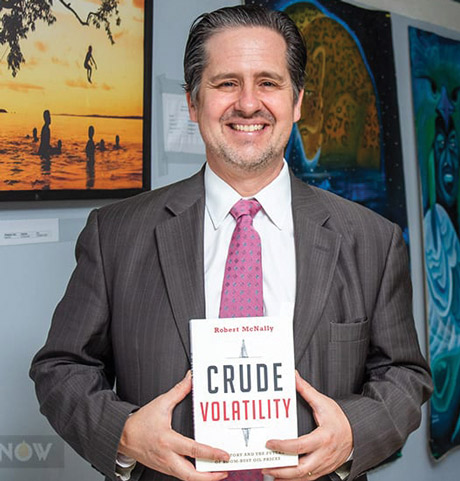
Georgetown – With global oil prices rising and falling as part of a continued “boom-bust” cycle, Guyana is being advised to embrace “observer’ status within the club of oil producers referred to as OPEC+.
“Get to know the other oil producers; get to know global oil management but try not to take (an oil production) quota,” international energy consultant Robert McNally told those gathered in the Education Lecture Theatre (ELT) of the University of Guyana Monday.
McNally, author of Crude Volatility: The History and the Future of Boom-Bust Oil Prices, was invited to Guyana by ExxonMobil’s Centre for Local Business Development as the first speaker in their oil sector teaching series for Guyanese titled “Join the Conversation.”
During the two-hour engagement he explained that in the absence of a non-OPEC “swing producer” the multi-national organization and its allies will continue to control global oil prices by choosing when to increase or decrease production. For this reason, he argued, it might be advantageous for Guyana to accept the invitation to join which is likely to be extended.
At peak production Guyana is meant to be producing 120,000 barrels of oil equivalent per day from the Liza-1 well. Production started up last month. By 2025, Guyana could be producing around 750,000 barrels of oil per day when two other wells come on stream.
“Guyana can act on the world stage to a degree it has not before; it will have power; it will have importance,” he noted, adding that the downside of joining is that Guyana will have to likely reduce production when OPEC+ orders such which would be bad for Guyana and for the producers.
“It is expensive to shut down production, it would delay cost recovery etcetera and Guyana would not want to do that,” McNally said.
The Organization of Petroleum Exporting Countries (OPEC) officially aims to “coordinate and unify the petroleum policies of its member countries and ensure the stabilization of oil markets, in order to secure an efficient, economic and regular supply of petroleum to consumers, a steady income to producers, and a fair return on capital for those investing in the petroleum industry.”
The organization functions by assigning “production quotas” to each member and increasing or decreasing these quotas to affect the availability and therefore price of oil on the global market.
According to McNally, OPEC might however give Guyana a “pass” since they want to see the country succeed.
“The world wants Guyana to succeed. Everyone sees the danger here and abroad and no one wants Guyana to go down that road. You will find a lot of friends internationally,” he stressed.
The “boom-bust” oil cycle also has serious implications for the national budget.
Asked by a member of the audience how this country can work to protect and advance its own interest in the face of the “self-interest” of these international friends, McNally said “hire outstanding talent”.
Guyana will have to do what a persons would have to do if they come into a lot of money, hire investment managers whose interest are aligned with Guyana, he advised.
“You will have to hire talent whose interest align with Guyana’s. Guyana’s government will have to be democratic, transparent and accountable. There is a global market place. It can be retired individuals with knowledge who want to help, it can be part of your diaspora…set parameters, be transparent and it’s possible,” he advised.
Since 2015, the Guyana Government has been sharply criticized for not hiring experts in a range of areas to protect the country’s interests.