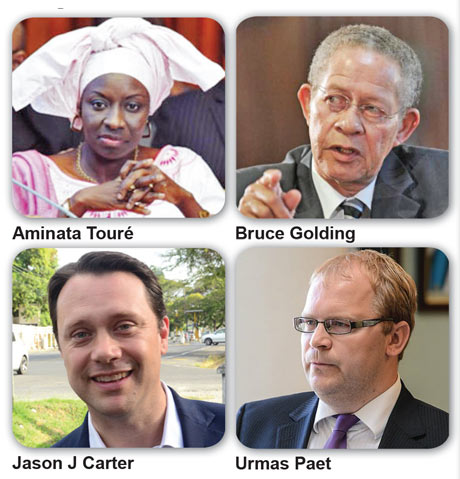
Georgetown – As the March 2nd date for Guyana’s General and Regional Elections draws closer, former Prime Minister of Senegal, Aminata Touré and Chairperson of The Carter Center Board of Trustees, Jason J Carter have stated that they are looking forward to be part of the election observation mission here.
And last week, Secretary General of the Organization of American States (OAS) Luis Almagro revealed that Former Prime Minister of Jamaica, Bruce Golding, will be leading an Electoral Observation Mission (EOM) on behalf of the OAS.
“The Carter Center and my grandfather, President Carter, care deeply about democratic governance in Guyana,” Carter said. “This election is an important opportunity for all Guyanese to rise above political divisions, respect democratic principles, and move together toward a brighter future. I look forward to returning to Guyana to observe this important election,” the Chairperson of The Carter Center Board of Trustees said last week.
Senegal’s ex-Prime Minister Touré said that she is honoured to co-lead the mission: “We hope the election will help move Guyana forward in the spirit of inclusive governance.”
The Carter Center has had a core team and group of long-term observers in Guyana since early January. Carter and Touré will arrive in the days leading up to the election to meet with key stakeholders – including political party candidates, civil society organisations, Government officials, and other international election observer missions, before observing polling, counting, and tabulation on March 2.
Last week, the European Union (EU) announced that it will be fielding teams of observers to cover every single region in Guyana. Member of the European Parliament, Urmas Paet has been appointed as Chief Observer of the Mission. These observers will be complemented by a team of analysts.
It was explained that there will be long-term observers deployed for six weeks countrywide. They will be replaced just before elections with short-term observers, who will be active during and after voting.
Also expected to participate in overseeing the elections is a team from the Caribbean Community (CARICOM).
GECOM is also getting assistance from a number of technical advisors who were provided by other countries and international organisations. Canada, for instance, is providing GECOM with Jean-Pierre Kingsley, a Canadian elections expert.
The Commonwealth is also providing the services of its senior technical advisor, Dr Afari Gyan, who arrived in Guyana last month. It is also understood that Dr Syed Nasim Zaidi, an elections advisor from India, is expected to join the team. In fact, Zaidi has reportedly arrived and met with the Commission.
This was the consensus of a three-person panel which on Monday evening addressed the question: what can bauxite teach us about oil?
The panel which was convened by Moray House Trust, though sparsely attended, sought to engage the public on the issue of the practical management of Guyana’s resources.
“So long as we are divided we will be exploited,” commentator Christopher Ram told the small gathering.
Speaking on the topic of “Oil: the story so far” Ram lamented the divisive nature with which those in political power have approached the negotiation, signing and implementation of the production sharing agreement with ExxonMobil and its partners.
“I’d like to see more reaching across the aisle. I’ve seen the manifestos. I’ve listened to the political meetings. Not one of them have said the morning after I win or I lose, I will call the other side and say we have to work in the interest of Guyana and that is so sad,” he said.
Though he was keen to point out that there are benefits for Guyana within the controversial 2016 Production Sharing Agreement with ExxonMobil’s subsidiary, he lamented the secrecy under which it was negotiated and called for an international commission of inquiry into the entire process all the way back to 1999.
“There is much the [People’s Progressive Party/Civic] must answer for and much the current government must answer for. We as a people, as ordinary citizens cannot be left with this haranguing,” he stressed.
According to Ram an international CoI conducted by any or a combination of the international organizations such Chatham House, Global Witness or Rystad Energy has the potential to rouse ExxonMobil’s shareholders and possibly bring the company back to the table.
“In Guyana reputation might not be important but for these companies it is,” he said, noting that at least one partner has already clearly stated that their main interest is shareholder happiness.
Trade unionist Lincoln Lewis who presented on the lesson learned from bauxite raised similar points as he noted that Guyana must have a national position on issues of employment within and management of the extractive sector.
He lamented the weakness displayed by both major parties in dealing with the Russian Aluminium (RUSAL)-controlled Bauxite Company of Guyana Inc. (BCGI).
“If you failed to manage bauxite why should we believe you can manage oil? If we can’t deal with RUSAL how de hell will we deal with Exxon?” he questioned.
Economist Sydney Armstrong who represented the University of Guyana provided a comparison of the economic performance of the two resources. He indicated that like the bauxite industry the oil Industry in Guyana will have a glorious period but Guyanese must prepare for after.