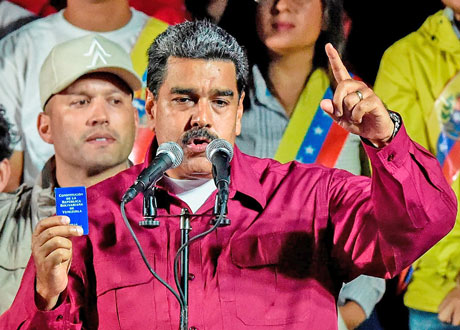
Caracas – Venezuelan president Nicolás Maduro faced a barrage of international criticism and the threat of fresh and potentially destablising economic sanctions after Sunday’s contentious election in which he secured a second six-year term in power. He shrugged off allegations of vote-buying and electoral fraud to claim what he called a historic, heroic and truly popular victory.
Maduro lashed out at the United States on Monday night after President Trump called him a “dictator” and US officials slapped the leader with sanctions over a controversial election.
British foreign minister Boris Johnson warned that the international community “may have to tighten the economic screw on Venezuela.”
Venezuela’s electoral commission said Maduro, who was first elected in 2013 following the death of his political benefactor, Hugo Chávez, received more than 5.8m votes compared to the 1.8m of his nearest rival, Henri Falcón. But, in a reflection of Maduro’s deep unpopularity at a time of severe economic turmoil, the official voter turnout was at a historic low of just 46.1%.
Maduro put a positive spin on the vote during a late-night victory address outside the presidential palace, hailing an “impeccable electoral process”.
“The whole of Venezuela has triumphed! Democracy has triumphed! Peace has triumphed! Constitutionality has triumphed!” Maduro shouted, adding: “The revolution is here to stay!”
But on Monday, the 55-year-old faced a wave of domestic and international censure as well as the looming threat of fresh economic sanctions.
Falcón, who on Sunday rejected the “illegitimate” election and called for a fresh vote, tweeted: “We will carry on working so there can be fair elections that will allow us to rescue our country from this totalitarian and wicked government.”
Spain’s prime minister, Mariano Rajoy, said the vote had “not respected the most basic democratic standards”. Rajoy tweeted: “Spain will study appropriate measures with its European partners and will continue to work to alleviate the suffering of the Venezuelans.” The 14-nation Lima group of Latin American countries plus Canada said its members did not recognise the election’s legitimacy and would recall their ambassadors from Caracas.
Speaking in Buenos Aires, where he is attending a meeting of G20 foreign ministers, Johnson said the group would “be talking about what we can do”.
He said: “The feeling I get from talking to my counterparts is that they see no alternative to economic pressure – and it’s very sad because obviously the downside of sanctions is that they can affect the population that you don’t want to suffer. But in the end, as one politician in this area said, things have got to get worse before they get better – and we may have to tighten the economic screw on Venezuela.”
The foreign secretary began his five-day visit to South America on Saturday in Peru, which – like other countries in the region including Brazil and Colombia – is now grappling with what experts call the worst migration crisis in recent Latin America history as Venezuelans flee their home. Johnson said: “They’ve got hundreds of thousands of refugees in Peru from Venezuela. They’re having to cope with a humanitarian crisis. They’re having to give them healthcare, they’re finding that in Peru they’re suffering new epidemics because of the condition of the refugees coming from Venezuela.”
Geoff Ramsey, a Venezuela expert from the Washington Office on Latin America, said new sanctions targeting Venezuela’s oil sector were very likely in the coming days or weeks. “That is obviously something that is extremely concerning because this is already a country that is in a deep economic crisis and we know that oil sanctions would have an impact on Venezuela’s people,” he said.
While Venezuela’s oil production had fallen under Maduro “the funds from oil exports still account for about 90% of the government’s coffers,” Ramsey said. “That’s money that is used to import food and medicine and it’s obviously badly needed at a time when there is mass scarcity of basic goods and people are dying of preventable diseases because they don’t have access to medication.”
Ramsey criticised Johnson’s “deeply cynical” warning that the situation may have to worsen before it improves. “That is using Venezuela’s populace as a political pressure tool. We’re talking about people that are dying because they can’t have access to medicine or basic goods and food. It is deeply cynical to use those people and their suffering in the hope that it might lead to some sort of political transition when that is not even a guarantee.”
While the sanctions could ultimately worsen the county’s food shortages, some protesters say it’s a risk they’re willing to take, since it might drive more Venezuelans to try to push out their government.
The Venezuelan election could replace the current legislative body, the National Assembly, with a new, 545-member Constituent Assembly, all nominated by Maduro’s administration.
The new, pro-Maduro assembly will have the power to rewrite Venezuela’s constitution.
“We have a Constituent Assembly. I said, come hell or high water – and hell and high water came – and the Constituent Assembly arrived from the hand of the people, from its conscience,” Maduro said.
Maduro argued that the Constituent Assembly will help bring peace to a polarized country, with all branches of the government falling under the political movement founded by his late mentor and predecessor, Hugo Chavez.
The US State Department said the elections were “designed to replace the legitimately elected National Assembly and undermine the Venezuelan people’s right to self-determination.”
Ortega, the country’s attorney general, said she “will not tolerate this and will not stand down. I will continue to be vocal about human rights abuses.”
Earlier this year, Ortega had her assets frozen and was ordered not to leave the country, but she has managed to stay in power.
“This is why they want to get rid of me,” she said. “I am bothersome for those involved in corruption.”
Maduro’s opponents control the National Assembly, holding 112 of the body’s 167 seats. The opposition has been battling with him for political power since they won a majority of seats in December 2015.
But before the winners of those elections took office, Maduro stacked the country’s Supreme Court with loyalists to prevent his own impeachment.
Speaking after Sunday’s controversial election, Maduro claimed that the opposition turned down an offer from his government to postpone the vote.
Two weeks ago, representatives of his government offered the opposition the chance to put up candidates for the Constituent Assembly election and to postpone the vote for 15 days, Maduro said. But the opposition refused Maduro’s offer, calling the vote illegitimate, the President said.
About 200 people gathered Monday night for a vigil in Caracas to honor the more than 121 killed in protests since April. They also gathered in opposition to the election results.
And on Monday, the attorney general decried the dozens of deaths and said the government doesn’t care.
“The government dances and laughs while our people are dying,” Ortega said. “This is the state of the country.”
The study, titled “Constraints Affecting Guyana’s Private Sector: Survey Results,” was authored by Guyanese economist Sukrishnalall Pasha, along with Elton Bollers and Mark Wenner of the IDB, who found that not only does it take longer for firms to access an electrical connection compared to their counterparts in the region (104 days compared to an the average of 62 days) but local firms also are subjected to more power outages, with longer durations.
Additionally, the study said that while only a few firms indicated that they were expected to pay a bribe for various government services, those who said they did estimated the cost as 4% of their annual sales figure.
This percentage is “significantly higher than the regional average of 1.8 % and the highest in the Caribbean,” the report explains. It notes that the cost of bribes is relatively higher for businesses in sectors such as machinery and equipment (25% of annual sales), fabricated metal products (11.7% of annual sales), and wholesale (10% of annual sales).
The services to which bribes were attached included securing an operating licence, electrical connection, telephone connection, import licence, water connection, and construction permit.
Specifically, 1.9% of firms reported that they were expected to pay a bribe to obtain an operating licence; 1.7% for an electrical connection; 1.7% for a telephone connection; 1.7% for an import licence; 0.8% for a water connection; and 0.8% for a construction permit. Based on the survey, approximately 6.7% of the firms indicated they were expected to pay a bribe to obtain the contract, while 3.3% claimed they were expected to pay a bribe to tax officers.
Significantly, though few identified as having paid bribes themselves, 34.45% of firms said they viewed corruption as a major obstacle, while 43.7% considered it a very severe obstacle.
Additionally, local tax rates were ranked by local firms as a significant obstacle to their operations. The report posits that this is due to Guyana having one of the highest corporate tax rates in Latin America and the Caribbean and it notes that some studies have found that the high tax rates motivate businesses to operate in the informal sector.
Unlike with the supply of power and corruption, there is no comparison presented of the tax rates in various Caribbean countries nor is there a comparison of the impact of tax rates as a constraint.
Data for the study was sourced from the 2014 IDB Study of Productivity, Technology and Innovation (PROTEqIN) in the Caribbean.
The PROTEqIN survey targeted 1,680 respondents drawn from Latin American and Caribbean Enterprise Surveys (LACES) 2011. It aimed to provide feedback from enterprises that participated in the previous round of surveys in 2011 and to capture additional information on firm performance, finance, gender of ownership and management, use of productive development programmes, and issues related to management style, innovation, and crime.
However, some of the Guyanese enterprises in the PROTEqIN final sample were not canvassed for LACES 2011.