reject Trump’s military threat
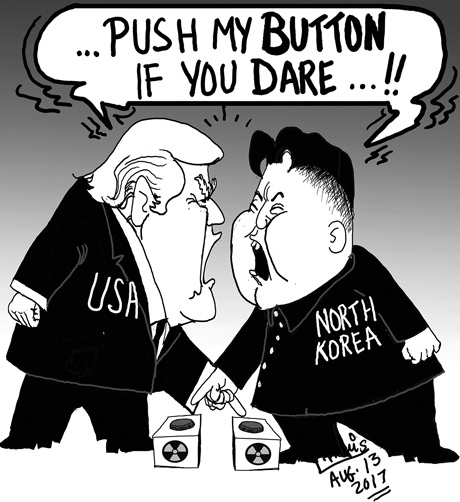
Latin American nations and Mercosur, the South American trading bloc, have condemned US President Donald Trump for saying he was considering military action in the Venezuela crisis.
On Friday, Trump told reporters the US had “many options for Venezuela, including a possible military option if necessary”.
“The people are suffering and they’re dying,” he added. Violent protests since April have left more than 120 people dead.
Venezuela’s foreign minister said Trump’s words had been hostile and disrespectful and risked destablising Latin America. The US has recently imposed sanctions on Venezuelan President Maduro calling him a dictator.
Argentina said dialogue and diplomacy were the only ways to promote democracy in Venezuela whose new constituent assembly can rewrite the constitution and override the opposition-controlled House.
Other Latin American countries also condemned Mr Trump’s comments, including Mexico, Colombia and Peru, which said the President’s threat was against UN principles.
Mercosur – which includes the region’s largest economies Argentina and Brazil as well as Paraguay and Uruguay – indefinitely suspended Venezuela’s membership.
Peru, a fierce critic of Mr Maduro’s government, on Friday expelled Venezuela’s ambassador after Caracas sent an “unacceptable” response to regional condemnation of its new constituent assembly.
Peruvian President Pedro Pablo Kuczynski has urged Mr Maduro to resign and called him a dictator.
By Dwarka Lakhan
(Final of 3 parts on Money Laundering)
Blacklisting by the US and the European community can have serious consequences for Guyana’s financial system and its people.
Although Guyana has addressed deficiencies in its Anti-Money Laundering and Countering the Financing of Terrorism Act (AML/CFT), it has limited enforcement and implementation capacity, leaving it vulnerable to money laundering.
The US State Department, in its “International Narcotics Control
In addition, it should strengthen requirements for suspicious transactions reporting, wire transfers, customer due diligence; and extend additional resources to the Financial Intelligence Unit (FIU) and the Special Organized Crimes Unit (SOCU).
And in a direct slap on the government, the US State Department report says that narcotics trafficking is evident in the country’s criminal justice system and other sectors. Incidentally, numerous press reports have alluded to this allegation, including the involvement of police officers in the drug trade.
Incidentally, several major agencies in Guyana are involved in anti-drug and AML efforts, including the Office of the Attorney General, the FIU, the Ministry of Finance, the Bank of Guyana, the Guyana Police Force, the Guyana Revenue Authority, the Customs Anti-Narcotics Unit, and the Special Organized Crimes Unit (SOCU).
In controlling drug trafficking, the US notes that the Government of Guyana has expressed a strong willingness to cooperate on drug control, extradition, and mutual legal assistance, and other international crime issues. However, cooperation is limited by resource constraints and high levels of corruption in the country.
Nonetheless, the US would welcome increased levels of cooperation with the Government of Guyana to advance mutual interests against the threat of international drug trafficking and looks forward to tangible progress on investigations, prosecutions, extraditions, security sector capacity enhancement, the engagement of at-risk communities, and enforcement of laws against money laundering and financial crimes. According to the US report, although the AML legislation gives the FIU authority to investigate alleged money laundering, the FIU does not have the capacity to conduct such investigations. The SOCU, on the other hand, only investigates those cases referred to it by the FIU.
However, the effectiveness of these agencies at investigating money laundering is limited, as they lack adequate human resources, training to ensure successful prosecutions, and a strong inter-agency network. Additionally, the lack of cooperation by the business community also hinders Guyana’s AML efforts.
Recently, the US agreed to support Guyana’s anti-money laundering regime by covering the cost of the initial training and support service required to implement software that would improve data collection and tracking of financial transactions.
In addition to methods of money laundering discussed in Part 2, the US report also identified other common money laundering methods including the use of fictitious agreements of sale for non-existing precious minerals to support large cash deposits at financial institutions; cross-border transport of small volumes of precious metals, declared as scrap or broken jewelry to avoid scrutiny by the relevant officials and the payment of relevant taxes and duties; Trade Based Money Laundering using gold, that is, the process by which criminals use gold to disguise their criminal proceeds; and the use of middle- and senior-aged cash couriers for the cross-border transport of large sums of U.S. dollars.
Invoice fixing is also another method of money laundering. Such allegations were apparently made against a large forestry company which has since run into trouble with the current government.
Arguably, it would seem as though both the US and the European Parliament are aware of incidences of money laundering which are not adequately dealt with by the government, causing the country to remain on their blacklists. They also recognize the existence of structural weaknesses in preventing money laundering and drug trafficking.
By being blacklisted, Guyana faces several counter-measures in the international community, among them, the requirement for enhanced due diligence measures; introducing enhanced reporting mechanisms or systematic reporting of financial transactions; refusing the establishment of subsidiaries or branches or representative offices of foreign banks in the country, and limiting the business relationships or financial transactions with Guyana or persons in Guyana.
In a local newspaper report following the earlier blacklisting by the CFATF, Governor of the Bank of Guyana, Dr. Gobind Ganga, is reported saying that blacklisting will not only result in a major cost to the Guyanese economy but also have adverse effects, including a slower financial process in terms of making payments, remittances, receipts from exporters; and decreased efficiency of financial engagement for businesses.
At that point in time, CARICOM expressed deep concern about the impact that any adverse action by CFATF Member States could have on the Guyanese economy and by extension the CARICOM Region as a whole, particularly in the areas of trade and financial services.
The regional body then stated that any action that reduces the ease or increases the cost of processing international financial or trade transactions will adversely affect trade and financial flows in the Region, retard the regional integration enterprise and reverse the gains made by Guyana and the region. CARICOM noted that this could also directly and severely hinder the functioning of the CARICOM Secretariat which is based in Guyana. The regional body was also mindful that blacklisting could result in hardship for the people of Guyana.
Paradoxically, the US has blacklisted 14 of 15 CARICOM members, including Antigua and Barbuda, Bahamas, Barbados, Belize, Dominica, Grenada, Guyana, Haiti, Jamaica, St. Kitts and Nevis, St. Lucia, St. Vincent and the Grenadines, Suriname and Trinidad & Tobago. The only CARICOM state that was not blacklisted is Montserrat, which is also a British Overseas Territory. Therefore Guyana finds itself in friendly company.
One of the other major consequences of blacklisting for Guyana and its CARICOM counterparts will be the unwillingness of international banks to act as correspondent banks for global transactions coming out of and entering the CARICOM countries.
In recent years, foreign correspondent banks have increasingly withheld their services to Guyana and other countries because of fear of financial penalties from the US if they are found doing business with suspected money laundering entities in the Caribbean.
As a result, the ability of these countries to conduct international transactions have been severely constrained, hurting businesses and even affecting individuals who depend on overseas remittances.
Commenting on being blacklisted by the US, Minister of Finance Winston Jordan is reported saying: “This now adds more to our misery. To lump all the countries which might be at various stages of the implementation of the money laundering legislation, to lump 14 countries which don’t appear on either FATF or CFATF list of countries in default, it is a sad blow to the Caribbean and it is a denial of recognition of the efforts made by all of these countries…to making our countries safer, to rid our countries of bad money,” he said.
He added that the region as a collective will now have to go back to the drawing board and come up with a plan of action to deal with the bold headlines.
His sentiments were echoed by Donville Inniss, Barbados Minister of Industry, International Business, Commerce and Small Business Development who called for a joint regional reaction against the classification.
“We are still 15 nations going into the international fora, grappling with an understanding of the issues and then perhaps 15 divergent positions on the matter, and I have been saying publicly and privately in regional meetings that we really need to come together,” Inniss is reported saying in the Barbados press.
He flatly blamed officials of the Guyana based CARICOM Secretariat and heads of government of the respective states for the lack of a united approach.
“It is like pulling teeth to get the folks in Georgetown, Guyana to understand the issues and I would go as far as to suggest that I do not think the leaders in the region appreciate the gravity of the situation,” he said.
Inniss’ call for coordinated CARICOM action was also echoed by Eastern Caribbean Central Bank Governor, Timothy Antoine, who pointed out that the world views the Caribbean as a brand or single entity. “It means that notwithstanding our heroic domestic efforts, larger countries, correspondent banks, regulators and even international institutions regard us as a homogeneous region. Consequently, the weaknesses of one often impact the reputation of all.”
Antoine added: “these international operators do not know and frankly spoken, often do not care, about our country-specific circumstances including our detailed implementation plans for certain reforms and standards.”
Incidentally, the current Chairman of CARICOM is Guyana’s President David Granger. Should he be leading the charge for Guyana and its CARICOM counterparts?