August 16, 2017 issue
Authors' & Writers' Corner
boy could dance!
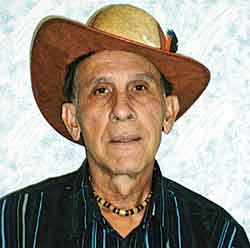
Bernard Heydorn
My wife and I recently did a dance performance for the residents in a long term care nursing home attached to a hospital in the region where we live. We did a mix of smooth and Latin dances, ballroom, disco, rock and roll, line dancing and more – thirteen different dances in all. It took about 45 minutes for the residents to be wheeled in to take their places around the room.
These folks were suffering from a variety of serious ailments, all incapacitating, some terminal. We didn’t quite know what to expect. One or two of the attendees seemed reluctant to participate, perhaps
preferring to have their afternoon nap in their rooms. Others looked at us with some curiosity commenting on my wife’s dress, my “regalia” as one pointed out, and particularly my black and white dance shoes with suede soles. One lady, originally from Poland, asked out loud where my tuxedo was, seeing that we were doing ballroom dancing. She said that was how they dressed in the old country. I have never worn a tuxedo in my life.

We followed that off with a fast moving cha cha which woke some of the residents up and won over the lady who commented about the tuxedo. From the seductive rumba to rock and roll, disco to big band, Elvis to the Beatles, we cast our spell!
Smiles started to appear on faces, hands started to clap, some feet, if able to, moved to the beat. The memory chains of long time days appeared to be turning the lights on. The magic of music and dance was beginning to take effect. A small group of inquisitive folks appeared in the hallway outside. Halfway through a non-stop performance I was sweating profusely and wondering if we were the right age for this kind of show.
As I looked around, some folks looked younger than we were, some not much older, and others more aged. I began to think, “There but for the grace of God, go I”. I could be sitting there disabled and or worse. All of a sudden, my problems seemed very light.
We went on to do a country style line dance which many had not seen live before. I told little stories about the dances and the places we had visited, like South Padre Island in Texas, and Portugal.
Then I suggested it was perhaps time to turn the lights down and do the tango. Sick heads snapped up at the mention of the tango. Now there is something about this dance that fascinates many folks and it is our most requested dance. I explained that we were going to do a ballroom tango and not the hot, hot Argentine tango. There might have been a few disappointed looks but we pressed on with our tango.
The audience by now was comfortable enough to request their own favourite dances, like the quickstep, the polka, the Viennese waltz and others. We had to explain that we did not have the music for all these dances and perhaps if we were invited again, we could do some of the other dances that they like.
Well it was time for the finale – the rousing Twist and Shout by the Beatles. I don’t know if you have ever seen septuagenarians (in their 70’s) twist but we gave it a good shot. Round and round we went, up and down we went, spinning and twisting, shaking all over, forward and back, even down to floor level and up again. It looked like some in the audience were going to fall out of their wheelchairs, trying to keep up with us! This was a fitting climax and finale.
Some stayed behind asking questions and thanking us as others were wheeled out. One man thought that I was from Cuba, I guess from the way my hips were moving in the salsa, rumba, and samba. Others were fascinated to hear that Vivienne had actually met the Beatles in England in the 1960’s. I invited those interested to come to the “autograph table” (smile) but no one took me up on it.
The whole experience was uplifting for both of us. The audience was very polite giving us a round of applause after every dance. A few had “oohed” and “aahhed” as we did a flick or a spin. To perform live gives one an adrenalin rush.
For both the audience and the dancers, the music is the message, the beat is boss. We love to dance. It’s a distraction, it’s movement, it’s merry, it gives us a chance to dress up, and it helps to keep us fit. It is also infectious. If we can bring a smile to the face of someone less fortunate than us, that is its own reward. We hope to keep on dancing to the end of time. If the creeks don’t rise and the sun still shines, I’ll be talking to you.
Jamaican heritage
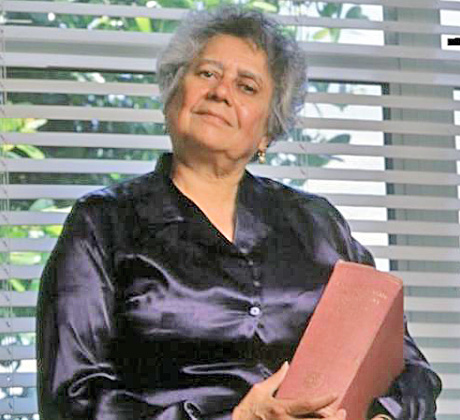
By Romeo Kaseram
Jean D’Costa was born Jean Constance Creary on January 13, 1937 in St Andrew, Jamaica, to parents who were elementary school teachers. Her father and mother, along with the young Jean and two older siblings, lived in various parts of rural Jamaica, the children attending the schools where the parents taught. As she later recalled to Joyce Johnson in Fifty Caribbean Writers, “My first memories are of the Jamaican countryside: village life, estate life, hills, empty Crown Lands and small coastal towns. We moved often, but finally settled in Kingston though I was sent to high school in the country. The experience of those years has had a very strong effect on my outlook and temperament.” According to the Cambridge University Press, it was in the Somerton district of St James where the most lasting effect occurred leading to her appreciation for rural life, which she would later reflect in the details of her writing. It was during these formative years, spent in rural Trelawny and St James, that language and culture left its lasting impression. Leaving for Kingston in 1944, here she discovered the Junior Centre, a children’s library at Half Way Tree. This library made as deep an impression as did the stories she heard while living as a young girl in rural St James. D’Costa began attending St. Hilda’s High School in Brown’s Town, St. Ann in 1948, followed by attendance at the St. Hugh’s High School in Kingston. After high school, she entered the University College of the West Indies, now the University of the West Indies, on an open scholarship, where she completed an honours degree in English, minoring in French literature, in 1958. The next year she travelled to England on an overseas scholarship to pursue a Master’s degree in Jacobean Drama at Oxford University.
D’Costa returned to Jamaica following her studies at Oxford University, and in 1962 began teaching Old English and Linguistics at UCWI. Between 1977 and 1980 she researched archaic Jamaican creole and culture, and was also a freelance writer. In 1980 she joined the staff at the Hamilton College in Clinton, New York, where she taught Caribbean Literature, Creative Writing, Linguistics, and Old English. Her first book, Sprat Morrison, was published in 1972. The main character in Sprat Morrison has since endeared himself to children in Jamaica and throughout the wider Caribbean. The novel was written for children coming into adolescence in Jamaican schools, and who at that time had little reading material relevant to their own lives. This was followed by Escape to Last Man’s Peak (1976), and Voice in the Wind (1978). These three books became required reading for first-year students in Caribbean high schools. D’Costa also wrote and published books for the younger seven to ten age group, among these being Duppy Tales (1997), Caesar and the Three Robbers (1996), and Jenny and the General, published in 2006. In collaboration with Velma Pollard, D’Costa produced an historical analysis of Jamaican language and culture in Over Our Way (1981), a collection of short stories for pre-teens. Along with Barbara Lalla, D’Costa also published Voices in Exile: Jamaican Texts of the 18th and 19th Centuries (1989), and Language in Exile: Three Hundred Years of Jamaican Creole (1990). Also along with Lalla, D’Costa published Roger Mais: ‘The Hills Were Joyful Together’ and ‘Brother Man’ (1978), a critical study of the Jamaican author Roger Mais. Also a poet, her writings were published in the anthologies Jamaica Woman (1980), edited by Pamela Mordecai and Mervyn Morris, and Waltzing on Water (1987), which was edited by Norma Mazer and Dorothy Lewis.
D’Costa’s academic writing has also focused on the Caribbean novelist and language. She writes in the Caribbean Literary Discourse: Voice and Cultural Identity in the Anglophone Caribbean: “…. the Caribbean writer works from a rich and complicated language culture that offers great opportunities for inventiveness and innovation. Far from perceiving our language situation in the Caribbean in terms of problematic, we should see this condition as the very means whereby we may explore and communicate the essence of our culture and its many links, past and present, with other language cultures. We must mediate between the forces of artistic convention, audience expectations, spoken and written forms, as well as differentiated but interlocking cultures. We must also recognise that each work of literary art alters, in however small a way, the language culture into which the new work enters. That, as linguists know, is how literary standard languages are created, and reshaped, and created anew.”
According to the Encyclopedia of Post-Colonial Literatures in English, “D'Costa's experience as a linguist has directly influenced her fiction, which emphasises problems of children's language development in an increasingly multilingual situation”. Additionally, “In reflecting the range of local language registers, D'Costa's fiction conveys the variety and complexity of Jamaica's cultural heritage. Having grown up in the waning days of colonialism, she is concerned with transition. Her fiction records important aspects of the material culture of rural Jamaica – which is being constantly eroded – and directs attention to the local landscape. Sprat Morrison (1972), her first novel, focuses on an important transitional stage for children in the formal educational process. Escape to Last Man Peak (1976), her second novel, is an adventure story exploring the anxieties of adolescents forced to rely on their own judgement and initiative. D'Costa's third novel, Voice in the Wind (1978), is set in Jamaica of the early 1940s and relates the formal educational process to the world of folk belief. D'Costa's quest for authenticity in re-creating the details of her characters’ existence gives her work a historical dimension. Her novels show how wider social issues impinge on a child's consciousness, balancing the claims of a material existence with the claims of the imaginative life.”
She retired as Leavenworth Professor Emeritus from Hamilton College in 1998. She received the Children’s Writers Award for the Jamaica Reading Association in 1976, the Gertrude Flesh Bristol Award from Hamilton College in 1984, and the Silver Musgrave medal from the Institute of Jamaica in 1994 for contributions to children's literature and linguistics. She lives in Florida.
Sources for this exploration: Encyclopedia of Post-Colonial Literatures in English; The Cambridge Guide to Women's Writing in English; Jamaican Information Services; Fifty Caribbean Writers: A Bio-bibliographical Critical Sourcebook, and Caribbean Literary Discourse: Voice and Cultural Identity in the Anglophone Caribbean.